


Best Invisible Wire Hair Extensions UK — What To Look For Before You Buy
 by Halo Hair Collective
Best Invisible Wire Hair Extensions UK — What To Look For Before You Buy
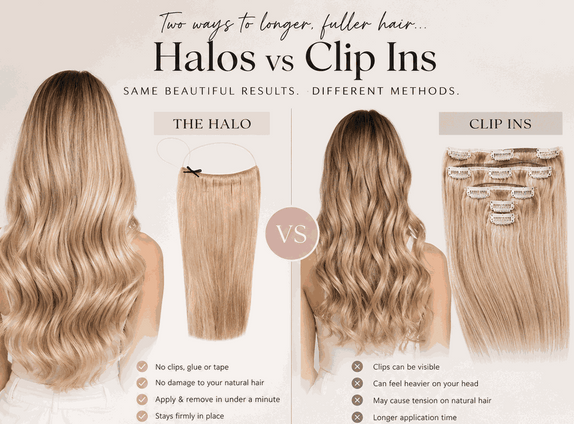
Invisible wire hair extensions — also called halo extensions — sit at the top of the market for a reason. No heat. No glue. No clips through your root hair. Just a near-invisible wire that sits beneath your crown hair and holds everything in place in under two minutes.
But not every halo extension is the same. Weight, hair quality, wire visibility, and the amount of hair in the weft all vary enormously between brands. Buy the wrong one and you'll spend weeks convincing yourself it looks fine. Buy the right one and you'll forget you're wearing it.
This guide covers every factor that actually matters so you can choose with confidence — and then explains how the Halo Hair Extensions range maps onto those factors.
1. Weight: Why Lighter Isn’t Always Better (and Heavier Isn’t Always Worse)
Weight is one of the first things buyers ask about, but it’s also one of the most misunderstood.
A halo extension that is too light won’t blend. It will sit on top of your natural hair rather than merging with it, and the line between your hair and the extension will be visible from a metre away. A halo that is too heavy pulls on the wire, shifts position throughout the day, and can cause a dull ache at the back of the head by evening.
The sweet spot depends entirely on your hair density. Fine or thin hair typically needs a lighter weft — usually in the 80–100 g range — so the extension doesn’t overpower the natural hair. Medium-density hair can carry 100–120 g comfortably. Thick or naturally dense hair often needs 120 g or more for the extension to blend rather than thin out visually at the join.
The key question: does the product list its weight? If a brand doesn’t publish the gram weight, treat that as a red flag.
2. Fine Hair vs. Thick Hair: Different Problems, Different Solutions
Fine hair presents two challenges with halo extensions. The first is coverage — your own hair must conceal the wire at the crown. The second is weight tolerance — fine hair simply cannot carry a heavy weft without the wire creeping upward or the join becoming visible.
For fine hair, look for:
- A lighter weft (typically 80–100 g)
- A wire that sits on a thin, soft monofilament or clear elastic — not a rigid plastic hoop
- A weft that has been constructed with density at the tips rather than just at the root, so the bottom of the extension doesn’t look thinner than your own hair
Thick or coarse hair has the opposite challenge. A light weft disappears into thick hair and the extension looks too thin below the join. Thick-haired buyers usually need the fuller, heavier options to achieve a seamless blend.
3. Human Hair vs. Synthetic: The Honest Comparison
Human hair extensions can be heat-styled exactly as you would style your own hair. They respond to humidity the same way your natural hair does, which means blending is easier because the texture and behaviour match. High-quality human hair maintains its appearance for 6–12 months or longer with proper care.
Synthetic extensions cannot be heat-styled with conventional tools (unless labelled heat-resistant up to a specific temperature). They hold a style well out of the packet but are less adaptable. The trade-off is cost — synthetic options are significantly more affordable, which makes them an excellent entry point for anyone who wants to try the halo format before committing to a larger investment, or for buyers who want a specific texture (curly, wavy) without the heat-styling effort.
Neither is universally better. They solve different problems at different price points.
4. Will the Wire Show?
This is the question every first-time buyer asks. The honest answer: it depends on the wire gauge, the wire colour, and your technique.
A good invisible wire extension uses a near-translucent monofilament or a wire matched to a light skin tone. It sits flat against the head, well below the crown layer of your natural hair. When positioned correctly, your own top section of hair falls over it completely.
Wire visibility is almost always an application issue rather than a product defect. The wire should sit roughly 3–4 cm back from your hairline. If it creeps forward — usually because the weft is too heavy for the wire adjustment — it moves into the visible zone. Adjusting the wire length is standard; every halo extension should come with guidance on how to do this.
If you have very fine or short layers at the crown, practice the placement in natural light before your first outing.
5. Optional Clips: Do You Need Them?
Many halo extensions come with optional pressure clips that attach at the sides of the weft and clip to your natural hair near the temple. These are not there because the wire doesn’t work — they’re there for high-movement situations: workouts, windy days, events where you’ll be dancing.
For everyday wear, most people don’t use them at all. If you plan to wear your halo to the gym or on a coastal walk, the clips give you peace of mind. They add no damage risk because they sit on the hair shaft rather than being threaded through the root.
6. Colour Matching: The Make-or-Break Factor
A halo extension that is the wrong shade will look unnatural regardless of how well it is positioned. Colour matching is arguably the most important factor in the whole purchasing decision, and it’s the area where most buyers go wrong.
Factors to match:
- Base tone (warm, cool, neutral)
- Depth (how light or dark)
- Ends vs. roots — if your hair is naturally lighter at the ends (from sun, bleach, or balayage), you want an extension that reflects this, not a single flat tone
If you’re unsure, use a professional colour matching service before ordering. At Halo Hair Extensions, the Colour Match Service is specifically designed for this: send in your details and get a shade recommendation before committing to a purchase.
7. Returns and Warranties: What to Confirm Before You Buy
Hair extensions are a considered purchase. Before ordering from any brand, confirm:
- Returns policy — can you return if the colour isn’t right or the weight doesn’t suit your hair? Are extensions returnable once opened?
- Warranty — quality human hair extensions should come with a manufacturer’s guarantee against shedding and weft construction defects
- Shade exchange — some brands offer a shade exchange programme specifically for colour mismatches
These terms vary significantly between brands. Reading them before purchase saves frustration.
8. Hair Quality: What Actually Differentiates Extensions
Not all human hair is graded the same. The factors that separate everyday extensions from premium ones:
- Cuticle alignment — in high-quality extensions, all hair strands run root-to-tip in the same direction. This prevents matting and tangling. Lower-quality hair strips or reverses the cuticle layer and coats it with silicone to mimic this — the silicone washes off after a few uses.
- Remy vs. non-Remy — Remy hair has cuticles intact and aligned. Non-Remy does not. Over time, the difference in longevity is significant.
- Origin and processing — single-donor hair (all from one person) maintains consistent texture throughout the weft. Blended or heavily processed hair is more likely to behave inconsistently after washing.
When a brand describes its hair as “premium” or “100% Remy human hair,” that claim should be backed by visible quality signals: the weight published, the weft construction explained, and a returns policy that reflects confidence in the product.
9. How Much Hair Do You Actually Need?
This is underestimated by most first-time buyers. A single halo weft adds volume and length to the back and sides of your head. It doesn’t add density to your parting, your crown layers, or your temples.
If your goal is to add 4–6 inches of length with moderate volume, a single weft is usually sufficient. If you want significant volume transformation, or if you have naturally thick hair that will ‘absorb’ the extension, a double weft or a fuller weight option is worth considering.
Hair density also matters for blend. Sparse ends on your natural hair will contrast with the density of the extension below the join. A weft with graduated density — thicker at the root attachment, tapered toward the tip — produces a more natural transition.
The Halo Hair Extensions Range: Which One Is Right For You?
With the above factors in mind, here is how the Halo Hair Extensions range maps to different hair types and goals.
The Halo — The Original
The Halo is the entry point into the range and the product that established the brand. It uses 100% human hair, is available in an extensive shade range, and suits buyers who are trying halo extensions for the first time or who have medium-density natural hair. Lightweight enough for fine hair when sized correctly, with enough body to blend with medium-thickness hair.
If you’re not sure which shade is yours, the Colour Match Service takes the guesswork out.
Deluxe Halo — Fuller, Thicker, More Volume
The Deluxe Halo steps up in weight and density. It’s designed for buyers who found a standard halo felt too light for their hair, or who want a more dramatic volume result. The weft is fuller from root to tip, which produces a denser, more luxurious finish. Ideal for medium-to-thick hair, or for anyone who wears their hair at a medium length and wants the extension to have visible impact.
Premium Halo — The Finest Hair Quality in the Range
The Premium Halo represents the top of the range in terms of raw hair quality. The hair is carefully sourced for consistent texture, cuticle alignment, and longevity. If you wear extensions regularly, style them frequently with heat, or simply want the best possible product for long-term use, the Premium Halo is the investment tier. It’s also the right choice for buyers with discerning colour requirements — the shade range includes nuanced tones that are harder to match at lower price points.
Syn Halo — Synthetic, Style-Specific, Great Value
The Syn Halo range offers the halo format in synthetic hair. Available in straight, wavy, and curly textures — or as a trio set — it’s designed for buyers who want a specific texture without heat styling, or who want to try the halo format before stepping up to human hair. At a lower price point, it’s a practical starting point, particularly for wavy or curly styles that would otherwise require daily heat work to achieve.
Before You Buy: A Quick Checklist
- ✓ Do you know your gram weight requirement for your hair density?
- ✓ Have you colour matched — or used the Colour Match Service?
- ✓ Do you know whether you want human or synthetic hair?
- ✓ Have you checked the returns and shade exchange policy?
- ✓ Have you confirmed the wire type and whether optional clips are included?
Invisible wire extensions are the least damaging extension format available. Get the weight and colour right and the result is seamless, comfortable, and genuinely difficult to detect. Get those two things wrong and no amount of careful placement will save it.
Take your time with the decision. The Colour Match Service is there precisely so you don’t have to guess.


Leave a comment